Jesse Smith's review of openSUSE 12.3 in this week's DistroWatch Weekly mentioned some installation difficulties that he encountered. In the DW comments section, "Andy Prough" posted the following:
One trick to installing openSUSE is to always try to download and install from the full DVD if possible. This distro doesn't seem to do near as well as Ubuntu and Mint at shoving everything you need into a smaller Live CD/DVD version. I've recommended that they stop producing the Live CD/DVD's if they aren't going to be able to control the quality of installation, or that they at least post a strong warning to avoid installing from that media. I think this may have contributed to the installation problems Jesse ran into as well.
If you go to the openSUSE forums, you'll find that most of the long-time users refuse to install from the live media or the Net install - they only use the full DVD. Although it takes longer to download, you get the added advantage of having a full repair disk plus an emergency off-line repository with thousands of software packages.
That's probably a good point; for my opensSUSE installations (12.1, 12.2, and 12.3 -- on a couple of different computers), I've used the KDE live disk each time. While I've managed to get each release installed, and each installation seemed easier than the previous one, my impression has been that openSUSE isn't the easiest distro to install. However, I figured that any difficulties I've had were the result of my not being familiar with the distro combined with the fact that I was adding them to my multi-boot set-ups.
Next time around, I may just do what was mentioned above -- go with the full DVD.
Monday, March 25, 2013

Saturday, March 23, 2013
kde's date and time
Configuring the KDE4 panel's digital clock is sort of a pain, mainly because settings aren't all in one place. Not a problem if you know what you're doing. If you don't... good luck. Prepare to spend a lot of time floundering.
I've finally gotten to the point where it takes me only a few minutes to get things tweaked to my satisfaction. Here's a look at how I did things in Fedora 17, with KDE 4.10.1.
Right-click on the clock and click on "Digital Clock Settings." The default settings look something like this:

Under "Appearance," the "Font" section controls the time's font, but not the date's font. I changed the Font to "Bold." In the "Information" section, I changed the Date format from "No date" to "Short date":

To tweak the date, first I clicked on the "wrench" button that sits to the right of the Date format. That opened up the "Country/Region & Language - KDE Control Module" window. I clicked on the "Date & Time" tab. The two fields I'm concerned with here are the "Time format" field and the "Short date format" field. With the cursor hovering inside one of the fields, suggestions show up, providing some helpful hints:

There's also a drop-down list that shows some strings you can use in the field.

In the "Time format" field, I used HH:MM to give me a 24-hour clock. In the the "Short date format" field, I used SHORTWEEKDAY SHORTMONTH dD. Those text strings are defined in the pop-up that appears when the cursor is hovering inside the field.
Finally, I clicked on "Apply" and closed the window. Back in "Digital Clock Settings" window, I clicked on "Apply" and closed that window, too.
At this point, the font for the time was in bold, but the font for the date was too small, and not in bold. To adjust the date's font: System Settings > Application Appearance > Fonts. The "Small" font setting is the one that is used for the the date.

The "Choose..." button brings up the following window:

A strange thing here is that the size of the time's and date's fonts are sorta connected. If you make the date's font larger, the time's font will shrink. I wanted to keep the date's font smaller than the time's font, but in the end the date's font was still a bit too small for my old eyes. This was remedied by increasing the height of the panel itself.

After all that, I had things the way I wanted them.

It's unfortunate that the KDE devs still haven't found a way to make all this much simpler, but with a little practice, the user can make short work of it.
I've finally gotten to the point where it takes me only a few minutes to get things tweaked to my satisfaction. Here's a look at how I did things in Fedora 17, with KDE 4.10.1.
Right-click on the clock and click on "Digital Clock Settings." The default settings look something like this:

Under "Appearance," the "Font" section controls the time's font, but not the date's font. I changed the Font to "Bold." In the "Information" section, I changed the Date format from "No date" to "Short date":

To tweak the date, first I clicked on the "wrench" button that sits to the right of the Date format. That opened up the "Country/Region & Language - KDE Control Module" window. I clicked on the "Date & Time" tab. The two fields I'm concerned with here are the "Time format" field and the "Short date format" field. With the cursor hovering inside one of the fields, suggestions show up, providing some helpful hints:

There's also a drop-down list that shows some strings you can use in the field.

In the "Time format" field, I used HH:MM to give me a 24-hour clock. In the the "Short date format" field, I used SHORTWEEKDAY SHORTMONTH dD. Those text strings are defined in the pop-up that appears when the cursor is hovering inside the field.
Finally, I clicked on "Apply" and closed the window. Back in "Digital Clock Settings" window, I clicked on "Apply" and closed that window, too.
At this point, the font for the time was in bold, but the font for the date was too small, and not in bold. To adjust the date's font: System Settings > Application Appearance > Fonts. The "Small" font setting is the one that is used for the the date.

The "Choose..." button brings up the following window:

A strange thing here is that the size of the time's and date's fonts are sorta connected. If you make the date's font larger, the time's font will shrink. I wanted to keep the date's font smaller than the time's font, but in the end the date's font was still a bit too small for my old eyes. This was remedied by increasing the height of the panel itself.

After all that, I had things the way I wanted them.
It's unfortunate that the KDE devs still haven't found a way to make all this much simpler, but with a little practice, the user can make short work of it.
Friday, March 22, 2013
four point ten
I've been using KDE 4.10 in Chakra for about a month and in Sabayon for a little more than a week. Yesterday, I was surprised to see updates available in Fedora 17 for KDE 4.10.1, so I brought 'em in.
 KDE4 is looking very good these days, and 4.10 seems like a very nice step forward from what's come before -- more polished, and faster.
Looks like Debian Wheezy will have KDE 4.8.4 when it finally becomes Debian Stable; Mepis will probably stick with what's in the Wheezy repos. I think that'll be fine for most Mepis users; I'm still using KDE 4.8.5 in openSUSE 12.2, with no complaints. But most distros are more up-to-date with KDE than Debian is, so the next Mepis release might be a tough sell for KDE-lovers -- unless rock-solid, Debian-ish stability is a primary concern, or unless the user is a devoted Mepis fan already. KDE 4.10 is already available via PPAs in Kubuntu, and the next Kubuntu release (in April) will come with it by default. openSUSE 12.3 comes with 4.10.0. Even PCLinuxOS is already at 4.9.5, I think.
But whether it's 4.8.x or 4.10.x, good times for KDE users.
 KDE4 is looking very good these days, and 4.10 seems like a very nice step forward from what's come before -- more polished, and faster.
Looks like Debian Wheezy will have KDE 4.8.4 when it finally becomes Debian Stable; Mepis will probably stick with what's in the Wheezy repos. I think that'll be fine for most Mepis users; I'm still using KDE 4.8.5 in openSUSE 12.2, with no complaints. But most distros are more up-to-date with KDE than Debian is, so the next Mepis release might be a tough sell for KDE-lovers -- unless rock-solid, Debian-ish stability is a primary concern, or unless the user is a devoted Mepis fan already. KDE 4.10 is already available via PPAs in Kubuntu, and the next Kubuntu release (in April) will come with it by default. openSUSE 12.3 comes with 4.10.0. Even PCLinuxOS is already at 4.9.5, I think.
But whether it's 4.8.x or 4.10.x, good times for KDE users.
Tuesday, March 19, 2013
a very good distro
While I'm looking forward to installing openSUSE 12.3 here, I haven't been in a hurry to do so, and I keep finding other things to do that seem more important at the moment. I'm typing this from openSUSE 12.2 (KDE), which has been so good that it's kinda hard to find a reason to move on to the next release.
The openSUSE releases go like this, according to their "Lifetime" page:
openSUSE releases have a lifetime of 2 releases + 2 months overlap. With a release cycle of 8 months this makes it 18 months.
So, the 12.2 release, which came out in September 2012, will be supported until around January 2014. I've got plenty of time. It might even be more intersting to ride with 12.2 until its end-of-life ("EOL"), just to see how things go; but, I'm pretty sure that I'll get bored one day and want to install the "current" release, or else I'll read about something that'll make me want to try it out.
Running openSUSE is not totally unlike running Debian Stable, in that you've got a long support cycle (although Debian's is longer -- over three years, something like that, depending on how things go), and a solid, stable system (if you run YaST to receive only security updates, mainly). Dependable; everything just works, no worries. Definitely one of the best distros I've ever run here.
The openSUSE releases go like this, according to their "Lifetime" page:
openSUSE releases have a lifetime of 2 releases + 2 months overlap. With a release cycle of 8 months this makes it 18 months.
So, the 12.2 release, which came out in September 2012, will be supported until around January 2014. I've got plenty of time. It might even be more intersting to ride with 12.2 until its end-of-life ("EOL"), just to see how things go; but, I'm pretty sure that I'll get bored one day and want to install the "current" release, or else I'll read about something that'll make me want to try it out.
Running openSUSE is not totally unlike running Debian Stable, in that you've got a long support cycle (although Debian's is longer -- over three years, something like that, depending on how things go), and a solid, stable system (if you run YaST to receive only security updates, mainly). Dependable; everything just works, no worries. Definitely one of the best distros I've ever run here.
Friday, March 15, 2013
new openSUSE
Downloaded the live KDE (32-bit) version of openSUSE 12.3 after reading this review. I burned the .iso onto a DVD using Brasero in Debian Wheezy.
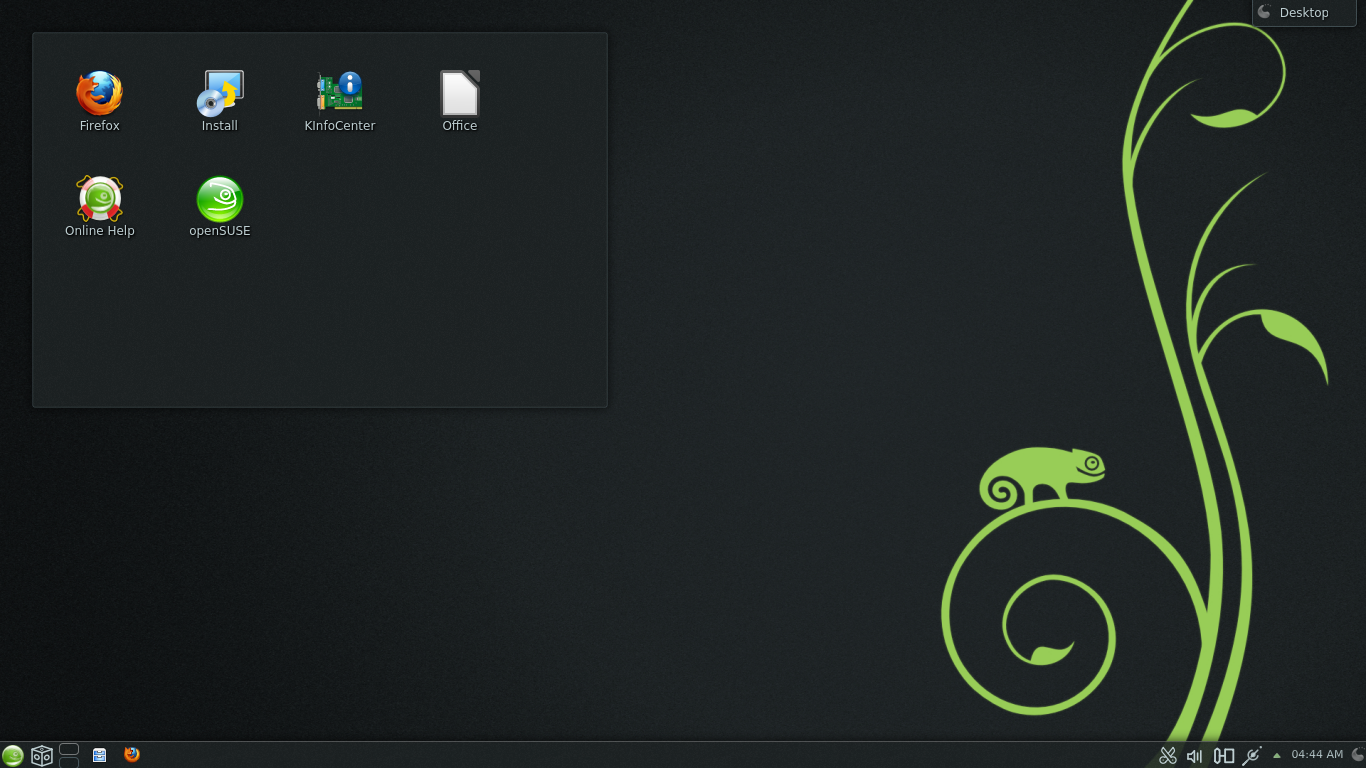
My first view after booting into a live session on my Compaq notebook:

A darker theme than what you usually see in openSUSE, but nice.
Default stuff includes KDE 4.10.00, Firefox 19.0, and LibreOffice 3.6. For more info, see the review that I mentioned above. You can also check out openSUSE's web site and their page at DistroWatch. Also, Muktware has a review already: openSUSE 12.3: Getting better and better
Everything in the live session looks fine here; I hope to do an installation within the next few days, if I get a chance.

My first view after booting into a live session on my Compaq notebook:

A darker theme than what you usually see in openSUSE, but nice.
Default stuff includes KDE 4.10.00, Firefox 19.0, and LibreOffice 3.6. For more info, see the review that I mentioned above. You can also check out openSUSE's web site and their page at DistroWatch. Also, Muktware has a review already: openSUSE 12.3: Getting better and better
Everything in the live session looks fine here; I hope to do an installation within the next few days, if I get a chance.
Thursday, March 14, 2013
about su
Here's an old article (but still a very good one) about the su command in Linux (thanks going out to "securitybreach" at the Bruno's All Things Linux forums): http://www.linfo.org/su.html
fedora?
I got going with Fedora with Fedora 14; since then, I usually have both of the most recent releases running here -- currently, F17 (KDE) and F18 (GNOME).
A lot of times, I guess you could describe Fedora as "Red Hat Sid/Testing." The new releases come every six months or so, and with the frequent kernel upgrades that come in (often every week or two), I experience more weirdness booting Fedora than I see in any other distro.
Yet, I enjoy running Fedora. I think they do an amazing job, considering what kind of distro it is. I prefer Fedora over running Debian Sid, or running Debian Testing all the time (I've had good experiences, however, with stepping into Testing a few months after the Squeeze and Wheezy "freezes"). Okay, every now and then I have to boot with the previous kernel instead of the current one, but other than that it seems surprisingly stable.
Of course, having it as one of the distros in my multi-boot set-up is one thing; using it as the sole operating system (and/or replacing Debian with it) would be another! On that note, some recent stuff from DistroWatch's comments section (looks like some people just aren't "feeling the love"):
Fedora is getting bad.
Their ill conceived updates victimize the users.
Things an update has broken on a running system , Not hackers but foolish mistakes from Fedora's update servers
No sound .
No mouse.
No Network.
And now.
No Firewall.
Dozens of rules changed by an update and no easy way to fix it. I find out. They renamed eth0 to p3p1 . I can not even find any info except iptables Shades of 1960's Debian Potatoe. I hate adding iptables rules, Manually.
I guess it is time to start using a real operating system written by someone who cares like Windows 8. I wont be back Fedora.
45 • re: MY choice of operating system (by Peter Besenbruch on 2013-03-14 04:20:44 GMT from United States)
Fedora Is THE distribution of bleeding edge change and to hell with the consequences. It's principal use is as a test bed for future Red Hat Enterprise Linux upgrades. Happy Fedora users are those who like the bleeding edge, and who don't mind tinkering. Hobbyists. If you need to get actual work done, Fedora is the last distro I would consider.
46 • @44 choices... (by DavidEF on 2013-03-14 12:07:11 GMT from United States)
"I guess it is time to start using a real operating system written by someone who cares like Windows 8. I wont be back Fedora."
I'm hoping you're being sarcastic, or in some way joking at least. But, in the off chance that you really BELIEVE that line, let me be the first to say: Don't come back. If you actually think Windows 8 is made by someone who cares about you, please don't ever use linux again, and please don't come back on here trolling again. No hard feelings, but have a nice life, and enjoy your Windows OS.
I can believe that the commenter on #44 believes what he/she wrote. I swore off of Fedora years ago due to difficulties in getting basic features working and also in keeping them working.
If the only two OS choices for a PC were Win8 and Fedora, and I were asked which one was crafted by a company that cares anything about the end user, I would not hesitate to choose Win8 either.
LOL! Stay away from Fedora! (Looking forward to F19...)
Subscribe to:
Posts (Atom)
